2. First & Second Grade Phonics Charts,
A Guided Path to Reading Success
Now that you have your Daily Phonics Practice in place, it's time to begin teaching and reviewing phonics patterns.
Phonics charts are one of the most valuable teaching tools you can use to help your child become a confident reader and speller. Each chart introduces one phonics concept or spelling pattern that your child will practice regularly.
and then you….
review, review, review
Build Your Phonic Binder or Charts
Introduce one new chart at a time. As your child learns each new phonics rule, simply add that chart to your growing collection. Before long, you'll have your own personalized set of phonics charts to use during your daily reading routine.
Right after your daily Phonic Drill go right into practicing 3–4 charts that have already been introduced. Draw attention to them when you notice them during both reading and writing times.
For homeschool families, I recommend printing each chart on 8.5" × 11" paper and placing two holes at the top so the pages can be flipped easily during your daily lessons. If you're teaching in a classroom, consider rewriting the charts on poster board or chart paper for easier visibility.
If you're beginning with first grade and have not gone through the kindergarten program with me, I encourage you to visit the Kindergarten Phonics Charts and add those foundational charts to your collection.
One final note: you'll often hear me refer to certain high-frequency words as "Red Words." These are words that don't follow the phonics patterns, so sounding them out isn't always helpful. I write these words in red as a visual reminder that they need to be recognized and not to waste time tying to sound them out. In the Phonics Charts section, I'll share in more detail the strategies I've found most effective for helping children master these challenging words.
1st & 2nd Grade Phonics Charts — A Guided Path to Reading Success
The first five charts begin our guided phonics progression. Each chart introduces a phonics pattern and gives guidance on how to practice each chart.
The charts are arranged intentionally—from patterns that build quick success from words most often found in beginning chapter books. As your child experiences success with each new pattern, you can continue adding new daily phonics charts. They do not have to have them mastered but also don’t add too many charts to fast.
Repeat the chants each time you practice the chart as that is part of the key to remembering.
Keep Practice Fresh
As your collection of phonics charts grows, choose 3–5 charts for each practice session. Mix familiar charts with newer ones to give your child variety and continued success.
Let your child choose some of the charts, or take turns—your child chooses two and you choose two. Giving children some control can make practice feel more enjoyable.
When the charts become familiar, keep practicing them! Instead of moving on just because your child “knows them,” use a simple reward system to keep motivation high.
For example, if you practice 5 charts, your child earns 5 pennies. When they save 100 pennies, they can trade them for $1 to spend in a small treasure box.
A little motivation can go a long way toward making daily practice something your child wants to do—not something they have to be pushed to do.
Packet 1 :Includes
EE — The “ee” Sound
A gentle introduction to a common vowel team pattern.
The H Brothers
Children learn how H changes the sound in familiar letter combinations.
Beginning Long Vowels
Introduces some of the first patterns children encounter for reading long-vowel words.
OW — Two Sounds to Notice
Helps children recognize that ow can make different sounds depending on the word.
OO — Two Sounds to Notice
Introduces the two common sounds of oo and gives children a way to recognize them.
Each chart includes its own teaching clues and reminders. You won't need to memorize a list of phonics rules—the chart gives you the language and clues to use with your child during practice.
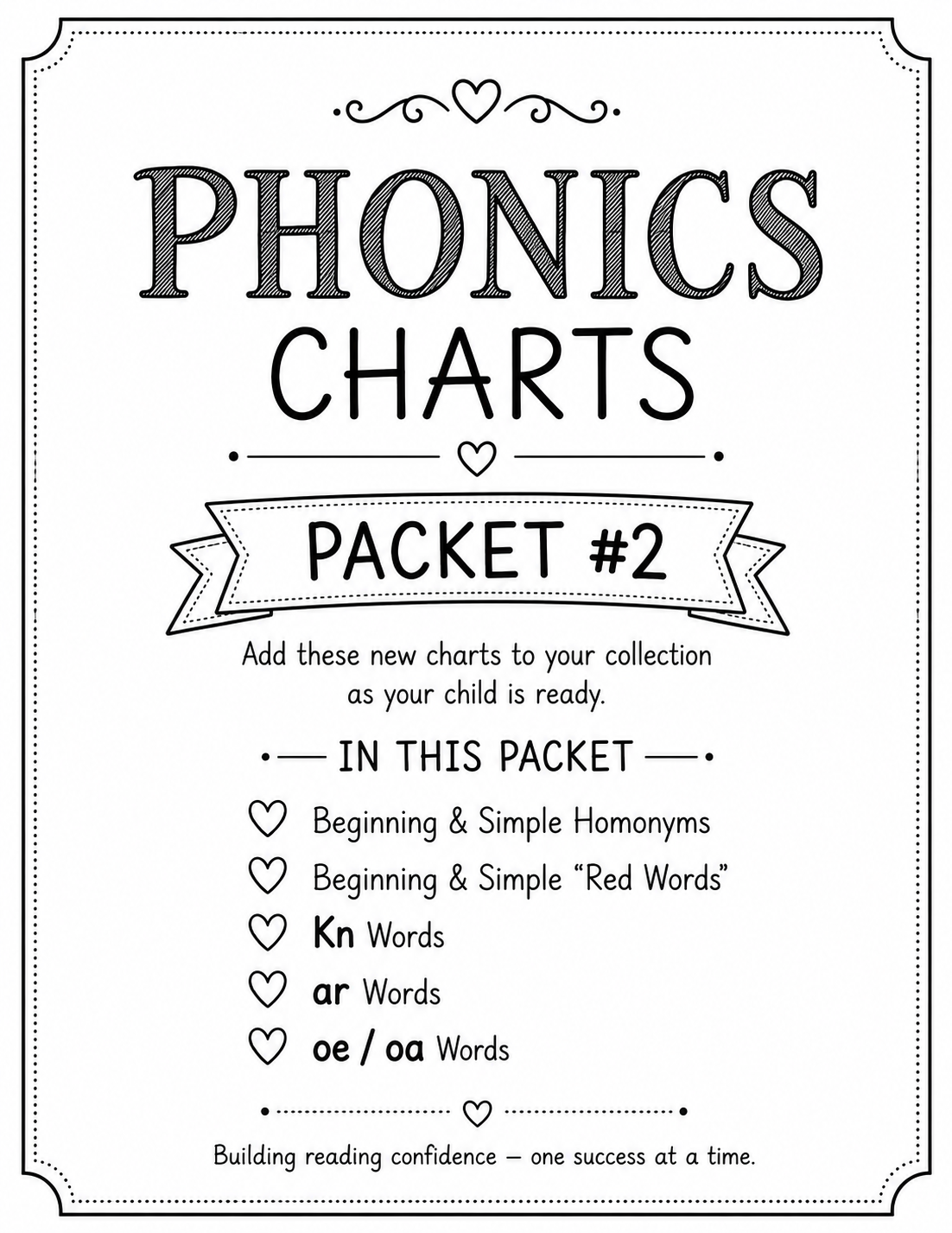
Packet 2: Includes
Beginning/Simple Red Words
Introduces some of the first high-frequency words children need to recognize during reading practice.
Beginning Homonyms
Children learn that some words sound the same but have different meanings and spellings.
AR — The “R” Sound
Children learn to recognize the special sound ar makes in words such as star, car, and park.
OE & OA — The Long O Sound
Children learn that when two vowels go walking, the first one does the talking and says its name.
KN — The “N” Sound
Children learn that in kn words, the k is quiet while n does the talking.
Each chart includes its own teaching clues and reminders. —the chart gives you the language and clues to use with your child during practice.
Each new packet is designed to be added to your existing charts. You do not need the cover page for the additional charts. It is best to introduce each packet in order but within each pack feel free to introduce in any order,
Now that you know the importance of and how to use phonics charts, you are ready to begin adding new phonics concepts and chart to your own set of Phonic Charts.